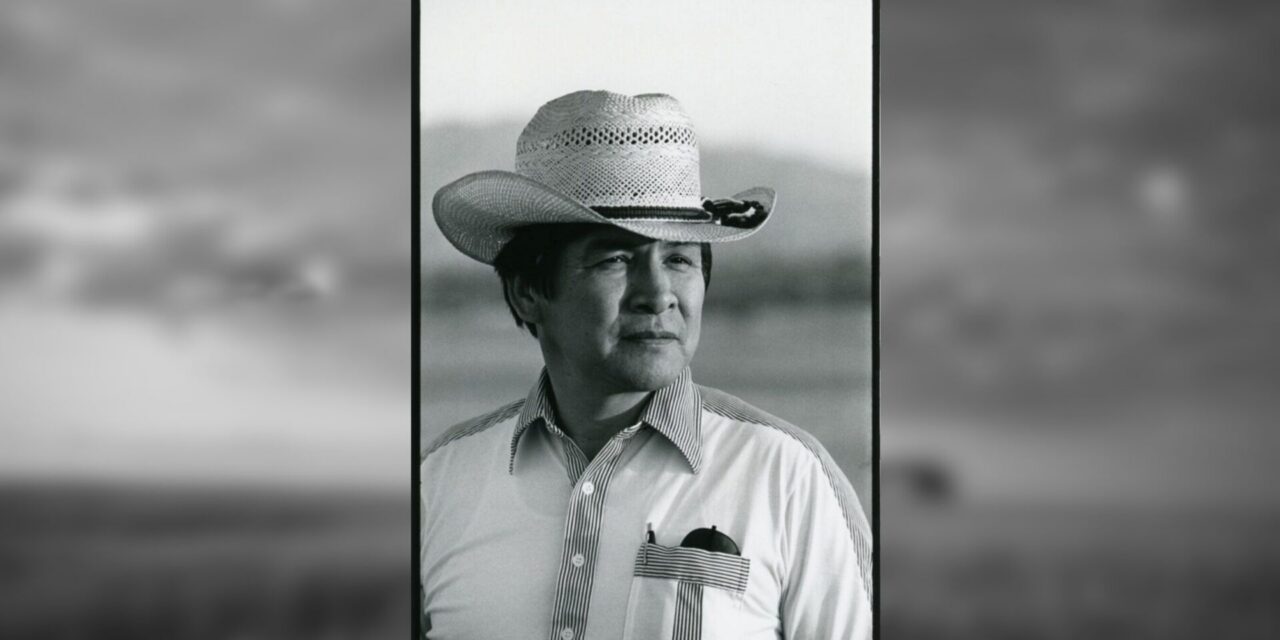
Nationally-known Native American evangelist and preacher Jimmy Anderson was a talented artist and singer, but his calling as a minister of the Gospel led him to choose preaching/singing over painting as his life’s mission.
Anderson was born on Aug. 14,1932 in Kansas City, Mo. and grew up in Holdenville during the Great Depression as a member of the Muscogee Creek Nation.
In 2016, KOSU and Fire Thief Productions produced a short documentary about Anderson, who served as preacher at Holdenville, Many Springs for decades.
According to the documentary, “He spent some of his youth at Yuchi Boarding School during World War II while his mother and aunt worked at a defense plant in California. To cure some of his homesickness, Anderson drew the backyard of his Oklahoma house from memory, and he eventually developed a talent for sketching and painting. After attending Haskell Institute in Lawrence, Kan., he went on to study at Bacone College in Muskogee with noted painters Fred Beaver, Pablita Velarde and Dick West in what was called the Oklahoma Flatstyle art movement.”
Painting continued to still be a part of Anderson’s life, but to a much lesser extent. As a testament to his talent, some of Anderson’s work is part of the collection at the Philbrook Museum of Art in Tulsa.
“Jimmy Anderson preached and served the Lord for more than 60 years,” said Emerson Falls, Oklahoma Baptists’ Native American Ministry Partner. “He pastored, started many Native American churches and led many mission trips all over the world. He surrendered to the ministry in 1956, was ordained in 1961 and retired from the pastorate in June 2022. He never retired from preaching though. He continued to share the Gospel through recorded sermons that were taken from home in his living room and broadcast on social media up until a few months ago.”
“I know I’m where I’m supposed to be and I made the right decision; well, the Lord made the right decision for me,” Anderson said. “I’m happy . . . at peace with what I’m doing in the Lord. But I don’t use my art anymore. I’ve still got visions of some paintings in my mind that I would like to do. But, boy, I’m just so busy doing my ministry, that it doesn’t leave me much time to just sit down and do some painting.”
 Anderson retired from the Southern Baptist Home Mission Board (HMB), now the North American Mission Board (NAMB), in 1998 and at Holdenville, Many Springs on May 29, 2022.
Baptist Press reported that Anderson was one of two men from the Muscogee Creek Nation honored on Sept. 19-20, 2025 at Bixby, First as “Native American Trailblazers” during the regional meeting of the Fellowship of Native American Christians (FoNAC).
Both and Ernest Best served for more than 50 years, Anderson as a pastor and national missionary; Best as a pastor and missionary evangelist. As pastor at Many Springs, Anderson often sang in English and his native Creek. He spent 34 years as a missionary with NAMB, traveling all over the world before retiring.
“These are two precious men who have devoted their lives to sharing the Gospel of Jesus Christ to the Native people of North America” FoNAC Executive Director Gary Hawkins told Baptist Press during the meeting. “I just wanted our people to recognize the tremendous impact these two servants of God have contributed, and also to focus on the challenge we face in the lack of people following in their footsteps.”
He said his love of music began at church.
“The music started in my life at Many Springs when I was young,” Anderson recalled in the KOSU documentary. “Nathan Buck, my cousin, used to lead gospel singing. I used to go to that and listen and hear and I tried to start singing with them.”
While at Haskell Institute, he also formed a trio (and then a quartet) with his brother Richard, J.B. Dreadfulwater, and Mitcheal Beaver. Together, they were the Osceola Four. They sang throughout high school, once auditioned for Ted Mack’s Amateur Hour, and performed on classic programs like the Sooner Shindig show.
“We got on television on Channel 4 and Channel 9 in Oklahoma City singing pop songs plus spirituals,” Anderson said. “We recorded one song with Spike Jones Orchestra. And that got to be on an album. So, we thought, ‘We might be the first all Indian quartet to make in big time if we pursue this.’ But the question I had was, ‘What should I pursue? Should I go ahead with my Indian art, music career, what?’”
Still, something kept bothering him. Every week in Oklahoma City, he saw Indian kids sitting outside of bars while their parents were drinking. His father had died from alcoholism, and he felt moved to do something. What direction should his life take? After fasting and praying, he chose to serve God and entered Seminary after his time at the University of Oklahoma. But, he never stopped singing.
Anderson was 29 when in 1961 he entered the Gospel ministry to reach his own Native people in Oklahoma. By 1964 he had become a missionary associate for the HMB.
He initiated and strengthened Native American work across the U.S.
He created a national Indian fellowship in 1987. That same year he started a national newsletter for all Southern Baptist Indian groups, and started work on an Indian Sunday School quarterly, even as he ministered among 39 Native American tribes in Oklahoma and still more across North America.
“Anderson has been instrumental in organizing mission teams to crisscross North America, starting and strengthening Indian churches,” according to a 1995 Missions USA article. In 1979 he was named HMB’s “Language Missionary of the Year,” and in 1994 he received HMB’s “Catalytic Missionary Church Planting Award.”
Anderson, at age 93 on Aug. 17, 2025, preached “last sermon.”
To read more, visit Anderson’s obituary here.